
Mental Health first: A new playbook for Sport
Kick4Life sport activities in Lesotho
Across our programs and projects, from Pemba in Mozambique to Reykjavik in Iceland, one thing stands out: when sport enters a community, playgrounds and fields come alive with the energy and movement of children and youth at play. Yet, beneath this apparent joy, many young people quietly navigate challenges that are not always visible: conflict, displacement, exclusion, or the everyday pressures that weigh on young minds. For many in this situation, sport can be more than a game: it can create a pathway to improved mental well-being, a space where healing, belonging, and confidence can take root.
On this World Mental Health Day, we want to highlight the resilience of children and youth who, with the support of our partners, are finding a powerful ally in sport to navigate adversity. Whether advancing girls’ mental health in Iceland, fostering inclusion in Lesotho, or supporting children whose communities have been hit by conflict in Mozambique, our partners show that caring for mental health begins wherever children and young people are given the chance to feel safer, more included, and more supported.
The positive impact of sport on mental health isn’t just something we observe in our work; it’s supported by data. Research consistently shows that sport can be a catalyst for better mental health, not just for elite athletes, but for anyone who participates. You don’t have to run a marathon or climb a mountain for sport to have a positive impact on your well-being. Even small amounts of movement can make a big difference. Here are some key data points at a glance:
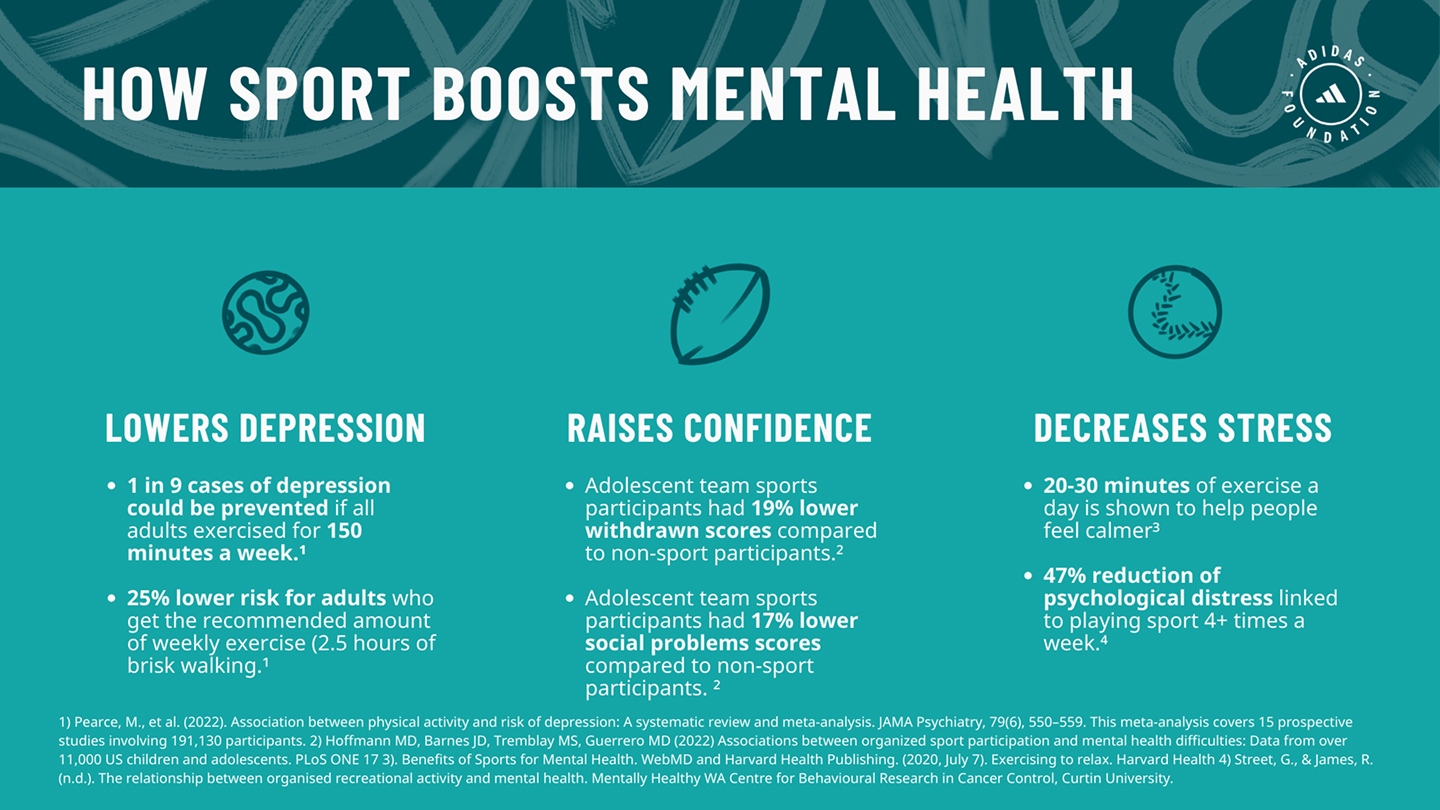
We know it’s not a given that sport fosters positivity, though. Sport can bring about new mental health challenges and exacerbate existing ones. From Olympic stadiums to community pitches, performance pressure can cause stress, expectations can lead to feelings of inadequacy, and bullying can push people out. Too often, there is no space to say you are struggling.
But that reality is gradually being transformed.
Elite athletes are opening up about their mental health journeys at the highest levels, destigmatizing the topic, while grassroots organizations are helping lead the way by creating spaces where everyone can access support, build community, and find joy through sport.
Some of the organizations leading the way are our partners. With our support, they’re helping build a world where sport is part of the solution to mental health challenges, not part of the problem. It’s about creating spaces where it’s okay not to be okay, and people have access to the support they deserve.
A hopeful future: Sport for Good organizations prioritizing mental health
We partner with Sport for Good organizations around the world that use the power of play for purpose. By intentionally focusing on well-being, our partners help young people and communities address their mental health challenges and access joy through sport. They work all around the world using their local knowledge and years of experience to create sport cultures that support people’s mental health journeys. To celebrate World Mental Health Day, we proudly share our partners’ stories below, along with links to our website where you can learn more about their work and our collaborations.
Bergið Headspace
Bergið Headspace is part of Legacy for the Future, our initiative with the UEFA Foundation for Children supporting gender equity projects in every country that played in the UEFA Women’s Euro 2025. Based in Iceland, Bergið Headspace works with 14- to 18-year-old young women who play football, supporting them in their mental health journeys. They deliver mental health education sessions to players, coaches, and referees, and offer young athletes private consultations. Bergið Headspace aims to increase mental health awareness and support in sport, help participants navigate challenges, and create environments where girls feel safer and more included.
“Through our program in Bergið, we focus on educating both young girls and their coaches about emotions and well-being. When coaches take an active role in the sessions, they become more aware and confident in their interactions, helping to build trust, understanding, and connection within the team. This approach promotes a healthier and more supportive sports environment where emotions are valued and understood.”
Fundación Ayuda en Acción
Our United by Sport partner, Fundación Ayuda en Acción has a project in Mozambique that uses sport to tackle discrimination, bring internally displaced people together with host communities, and support participants’ mental well-being. By integrating emotional and psychological support into sport and school environments and providing counselling services, the project works directly with young people on their mental health journey. Programming includes weekly inclusive sport sessions for children with disabilities, aimed at preventing bullying and making sport more accessible. In partnership with Save the Children, the project also trains key personnel, such as coaches and activists, to help young people navigate stress and trauma and to create environments where everyone feels welcome.
“Mental health is not built only in clinics, but also on playgrounds, in classrooms, and in group circles - where children rediscover their right to play, dream, and believe in better days.”
Helpcode Italia
In Yemen, Helpcode Italia works with mental health professionals to help participants navigate challenges and prioritize their well-being. Their approach includes training psychosocial facilitators, teachers, and caregivers to identify signs of abuse, equipping participants with essential skills to foster safer environments, and connecting athletes to psychosocial support. Ultimately, HelpCode Italia’s project aims to enable people in Yemen to build resilience and drive positive change within their lives and communities.
“In our child-friendly spaces, we combine structured sports sessions with psychosocial support activities to create safe environments where children can express themselves, build confidence, and regain a sense of normalcy. One of the most powerful moments we witnessed was a child who, initially withdrawn, gradually regained confidence through team games. Seeing them laugh and eventually lead their peers reminded us that mental health support in safe spaces truly changes lives!”
Kick4Life
In Lesotho, Kick4Life helps advance gender equity and LGBTQIA+ inclusion, enabling people of all backgrounds and identities to thrive. Their work centers on making football more welcoming and supporting LGBTQIA+ participants, many of whom face mental health challenges due to stigma and discrimination. Through a holistic approach, Kick4Life connects players with counsellors, creates more inclusive sport sessions, and provides transport assistance so participants can travel safely to and from activities and continue playing.
“At Kick4Life we use sport to empower children and young people in Lesotho to protect their mental health and wellbeing. We promote healthy lifestyles, positive friendships, and skills such as problem solving, resilience, and stress management. For those facing challenges like abuse, family loss, or poverty, we connect them with specialist mental health support.”
- Steve Fleming, Kick4Life Co-founder
The Athlete Survivors’ Assist x Sport & Rights Alliance
The Athletes Survivors' Assist and the Sport & Rights Alliance (SRA) collaborate to tackle abuse and discrimination in sport worldwide. Their joint project brings together The Assist trauma-informed expertise and SRA’s global leadership, focusing on every level of sport, from grassroots to professional athletes. By working with a diverse range of experts, they strive to make sport safer and more inclusive for all. The project enables athletes who have experienced discrimination and abuse to report incidents, seek support, and advocate for more inclusive and safer environments. Coaches and human rights professionals are equipped with anti-discrimination strategies to help transform sport culture. And at the international policy level, the project supports global sport governing bodies in developing inclusive policies and practices.
“I believe there has been a genuine improvement in how we discuss mental health in sports. Now more than ever, athletes and advocates want to go beyond the term itself and into the nuances of what it means, how people are impacted, and where accessibility and support are most vital. We have a long way to go, but I’m grateful the conversation is more open than ever. Mental health, especially for young athletes, must remain a priority in their success.”
- Devi Jags, The Athletes Survivors’ Assist
“For too long, sport’s 'win at all costs' mentality, hypermasculine approach and hierarchical structures have enabled systemic emotional and psychological abuse. Led by impacted athletes and supported by alarming prevalence studies, in recent years global sport has started to recognize and respond to this crisis. Much more needs to be done – especially for athletes in the Global South, children, women and the LGBTI community – from education and early recognition, to being ready to respond. Athletes’ courageous resilience and inspiring determination have shown us that reinventing sports culture is not only urgent, but it is possible.”
- Andrea Florence, Executive Director of the Sport & Rights Alliance
Around the globe, from Iceland to Mozambique, from Yemen to Lesotho, and across global alliances, these partners are demonstrating that sport can be a powerful force for healing, resilience, and inclusion. On World Mental Health Day, and every day, we are proud to stand with them in putting mental health first, and building a future where every player, coach, and community can feel safe, supported, included and valued.
Around the globe, from Iceland to Mozambique, from Yemen to Lesotho, and across global alliances, these partners are demonstrating that sport can be a powerful force for healing, resilience, and inclusion. This shows, at the adidas Foundation, mental health is central to our work. Improved mental health, resilience and self-esteem are indicators for the impact we want to create. We believe sport can and should be a vehicle for healing, resilience, joy, and connection. That belief shapes our programs, partnerships, and the culture we’re working to build.
“It takes intention and collaboration to cultivate spaces where people feel comfortable to be vulnerable and face their struggles. Together with our partners, we’re working hard on building a sport culture where everyone feels safer, more seen, and supported.”
- Melissa Kaar, adidas Foundation Managing director
As our managing director, Melissa Kaar, pointed out: “When mental health is put first in sport, something special happens. It creates room for people to work through challenges, connect, and grow. But it takes intention and collaboration to cultivate spaces where people feel comfortable to be vulnerable and face their struggles. Together with our partners, we’re working hard on building a sport culture where everyone feels safer, more seen, and supported.”
This is why a focus on mental health is crucial for any sport for sustainable development and peace initiative, yet it needs to be intentional. On World Mental Health Day, and every day, we are proud to stand with our partners in putting mental health first, and building a future where every player, coach, and community can feel safe, supported, included and valued.