
Safe to Play: How our partners are creating safer spaces for women in sports
Editor’s note: In this article, the terms “women” and “girls” are used in an inclusive way, acknowledging that gender-based violence affects women, girls, and people of diverse gender identities who are perceived or treated as such, including trans and non-binary people.
Sport has a unique ability to bring people together — to create shared moments of joy, belonging, and collective pride across communities and generations. But it can also mirror the broader inequalities within society, including the gender norms that shape women’s and girls’ everyday realities.
In England, for example, research shows that certain domestic abuse incidents rise on match-days when the national team is playing in a major tournament.¹ This does not mean sport causes violence. Rather, it highlights how existing gender inequalities and violence against women can intensify during moments of collective tension or celebration. Observed again during UEFA EURO 2024², this pattern underscores a deeper truth: the environments we build around sport matter.
This isn’t only an issue during major events. It is deeply rooted in everyday spaces where sport takes place — community clubs, school teams, public courts, and informal play. These environments shape how young people learn to treat each other, how they respond to stress, and how they build relationships. They can also offer important role models and create spaces where confidence, belonging, leadership, and assertiveness can grow. This applies especially for women and girls, who often face barriers tied to unequal safety, representation, and opportunity³.

Participants of the ASD Balon Mundial activities in Torino, Italy
As we mark the International Day for the Elimination of Violence Against Women, one message is clear:
With the right approach, sport spaces can move from reproducing harm to driving prevention.
Shaping Sport as a Tool Against Violence
At the adidas Foundation, we see sport not only as a mirror of society but as a platform to challenge a status quo where women are often not protected.
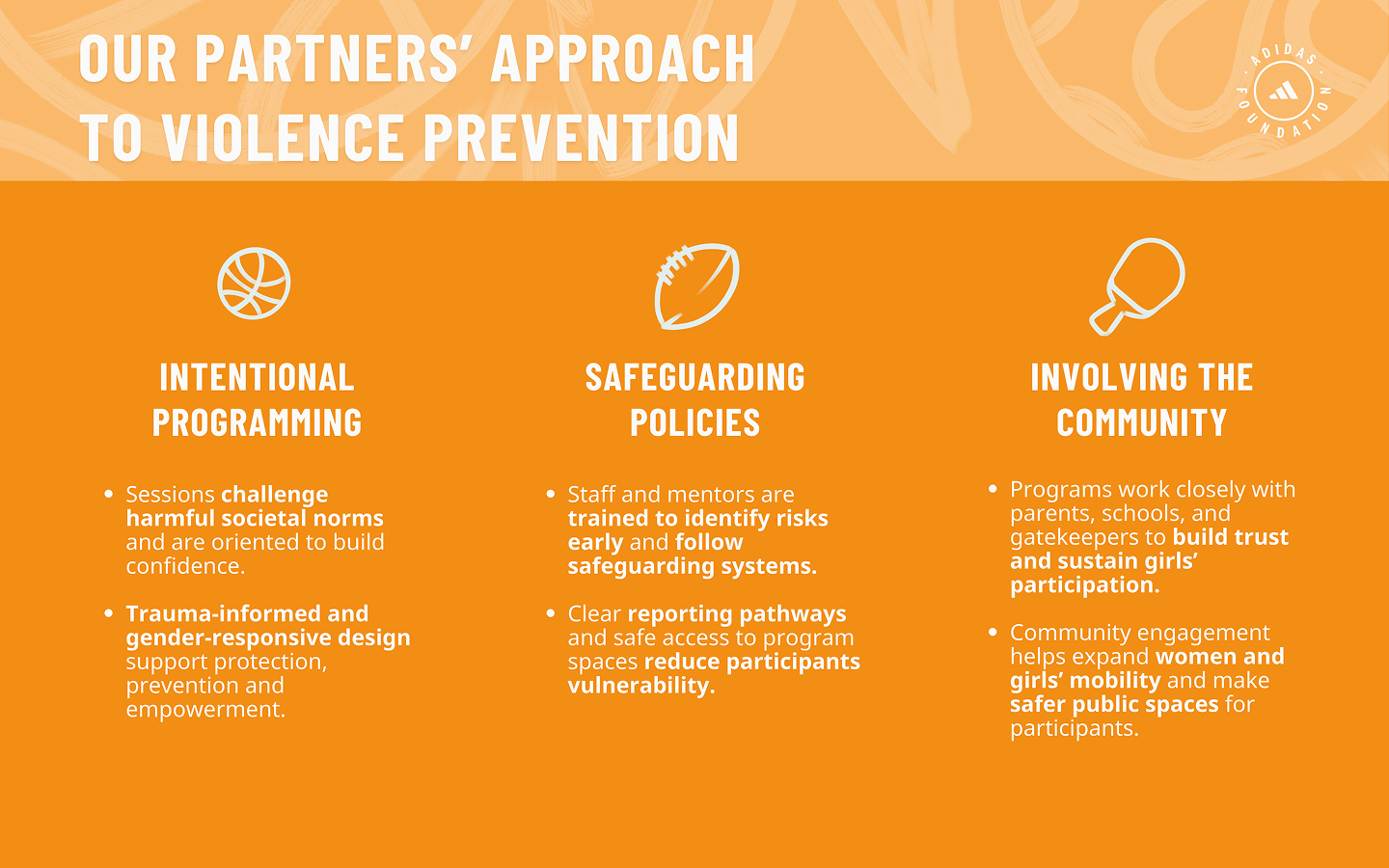
Some of the key insights after asking a selected group of partners' about how the key factors they work on to prevent Gender-based violence in Sport
Our approach focuses on shaping sport as a preventive tool to reduce violence and strengthen social cohesion. We therefore support our partners in creating safer, more inclusive spaces grounded in strong safeguarding standards.
Within these environments, partners build sport sessions intentionally designed to promote inclusion, anti-discrimination, and the prevention of violence. The projects seek to empower children and young people to actively challenge harmful norms and promote equality – also through gender-responsive and trauma-informed practices.
Research supports this: well-designed sport-for-development programs have strong potential to create safer, more equitable communities.⁴
“The main challenge remains the transition to adolescence, when external societal pressures and the lack of role models can reduce female participation.”
- Balon Mundial Team
Early prevention is especially critical. As the team of Balon Mundial, our Legacy for the Future partner in Italy helping young women and non-binary people develop social, emotional, and leadership skills through sport, explains: “Through our work with young people, we have seen that sport fosters teamwork, self-esteem, and social inclusion. It allows girls to gain visibility in spaces where they are often underrepresented. The main challenge remains the transition to adolescence, when external societal pressures and the lack of role models can reduce female participation. Sport, combined with cultural engagement, provides a universal language that promotes positive social norms and counters discrimination.”
We don’t have all the answers on how sport can fully realize its potential as a safe and joyful environment where women and girls can thrive free from violence. But across our partners’ work we see a clear pattern: when participants feel safe, count on supportive relationships, and have early opportunities to challenge harmful dynamics, sport becomes more than a game: it can become a pathway to protection, dignity, and equality.
Role Models and Safe Participation
Role models play a key role in this process. When girls and young women see people who look like them leading, coaching, and taking up space in sport, it challenges gender stereotypes and increases their sense of safety and belonging.
In East Nusa Tenggara, our partner Plan International Indonesia reinforces this by using football as an entry point to address gender-based violence, creating safe training spaces, engaging parents and teachers, and ensuring girls are supported by women coaches they can trust. As the Plan International Indonesia team shared: “Since the football teams are girls, we decided to recruit women football players and coaches. In the early assessment, girls in our targeted school mentioned that they would be more comfortable having women coaches.”
“Empowering girls also means protecting them. We invest in safeguarding systems, train our partners and staff, and create environments where girls can participate without fear.”
- Dini Widiastuti, executive director of Plan International Indonesia
Coaches carry immense responsibility. They need the right tools, training, and systems to protect participants. As Dini Widiastuti, Executive Director of Plan International Indonesia, notes: “Through programs like Girls Football, we are reminded that empowering girls also means protecting them. We invest in safeguarding systems, train our partners and staff, and create environments where girls can participate without fear. Every safe space we build brings us closer to a world where all girls are free to achieve their dreams.”
Global research also shows that preventing violence in sport requires engaging with the gender dynamics that influence how boys and men interact with women and girls. In many sporting environments, man coaches, administrators, and peers still hold most leadership and decision-making power, a pattern highlighted in international studies on gender equality in sport.⁵ Without intentional training and accountability structures, these dynamics can reinforce unequal power relations and increase risks for girls and women.⁶ It is therefore clear that boys and men must be part of the solution—learning to model respect, share space, challenge harmful norms, and support the safety and participation of women and girls.⁷
From Theory to Practice: Partners Leading Change
Across our network, our partners are using sport to engage communities and challenge harmful norms with the goal of helping women and girls.
In Iraq,— where an estimated eight in ten women report experiencing some form of sexual harassment —⁸ the urgency of this work is particularly clear. Where restrictive social norms limit girls’ mobility and access to safe environments, sport-based programs can become powerful tools for redefining what is possible. They contribute to shift who is seen, who belongs, and who has the right to occupy public space. As Insherah Musa, Country Director in Iraq for our partner Free to Run, puts it: “When girls run together in public, they reclaim public space and strengthen their self-confidence; both are key factors in reducing vulnerability to gender-based violence. Sport and physical activities work to build peer networks and trust with trained women mentors, encouraging girls to discuss sensitive/taboo topics and disclose concerns earlier.”
Free to Run organizes weekly activities in safe and inclusive spaces - with running sessions strategically held in public areas to challenge gender norms and promote women’s visibility in society. Through the program, participants actively contribute to shifting attitudes about a woman’s role in society and their leadership potential.
(in Iraq) “when girls run together in public, they reclaim public space and strengthen their self-confidence; both are key factors in reducing vulnerability to gender-based violence.”
- Insherah Musa, Country Director Iraq For Free To Run
The initiative also works with community members to address harmful gender stereotypes, spending significant time and resources in getting buy-in from parents, spouses, and other “gatekeepers”, at the start of each program cycle, to build rapport and trust, and ensure participant attendance and retention throughout the program.
The work of Free to Run, Balon Mundial, and Plan International Indonesia shows what’s possible at the community level but these efforts must be matched by changes in wider systems. When societies build inclusive structures and address the systemic discrimination present in sport, participants in these programs have greater opportunities to thrive.⁹
This is where our partnership with the Athlete Survivors’ Assist and the Sport and Rights Alliance plays a key role. This collaboration supports a global network of athletes, whistleblowers, and allies working to address and respond to abuse, trauma, and discrimination in sporting environments, while also providing platforms to drive public awareness and advocate for meaningful policy change.

Participant of the Plan International Program in Indonesia. Photo credit: ⒸYayasan Plan International Indonesia
Insights from The Assist show why this system-level work matters. Their experience highlights that safety and protection do not depend on programs alone, but on the institutions, and cultures surrounding young people. As the Team of The Assist puts it: “When coaches are trauma-informed and clear safeguarding pathways exist, athletes are supported as whole individuals — reducing vulnerability, increasing confidence, and strengthening the protective factors essential to long-term violence prevention.” The Assist works to ensure these principles are not isolated practices but part of a wider structural shift in sport.
Safer Sport Spaces for Women and Girls: A Shared Responsibility
Across contexts, partners point to the same root issue: structural inequalities and discrimination.
For Insherah Musa, Country Director of Iraq for Free to Run, the biggest challenges to reduce gender-based violence are “(the) restrictive social norms, limited mobility for girls, and under-resourced protection systems in displacement settings, make it a challenge to sustain community engagement and safe access to public spaces”.
In a completely different context in Indonesia, the identification is quite similar, according to Plan International Indonesia: “Although the schools start to show positive encouragement towards girls’ participation in football, sustainability of the impacts also depends on the time, efforts and fund investment from the government (schools included) and the football association. As the football association are still dominated by men, advocacy to change this are still very much needed.“
What heir insights reveal is a shared understanding: the norms, institutions, and protection systems surrounding women in society must be transformed in order to build truly safe spaces for participants and a sport environment that is genuinely inclusive.
A shared message emerges:
Transforming sport requires transforming the norms, institutions, and protection systems surrounding women and girls.
Sport will always reflect the society around it, but with the right approach, and by addressing these shared challenges, it can also help transform it.
A Call to Action
Our partners have shown us that when sport is grounded in early prevention, supported by safe and intentional environments, and backed by structural advocacy, it can:
- shift harmful mentalities,
- strengthen supportive communities, and
- empower women and girls with a deep sense of belonging.
On this International Day for the Elimination of Violence Against Women, let this be our reminder:
We all share responsibility in ensuring that sport is part of the solution — not part of the problem.